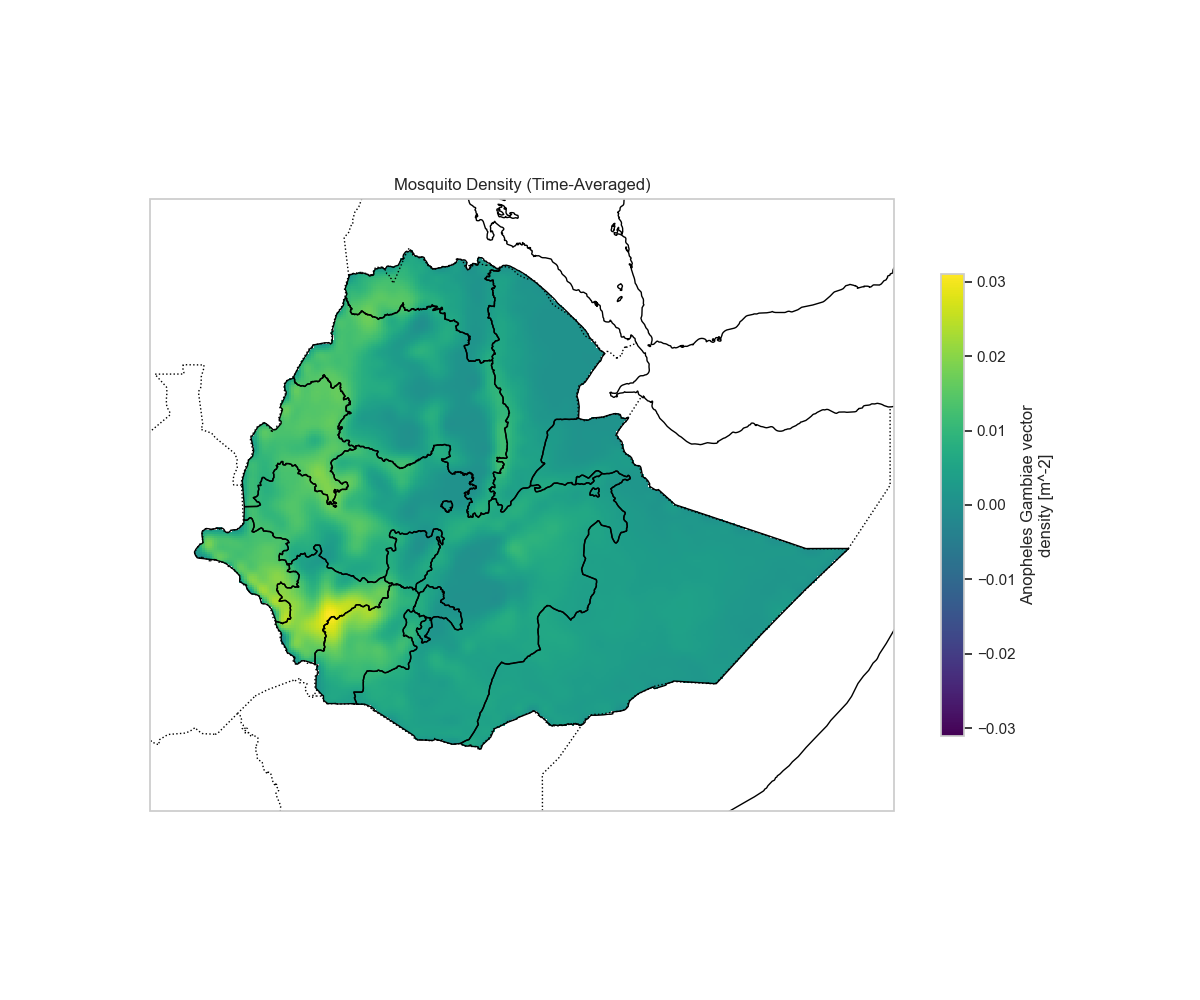
Spatial Patterns
Time-averaged mosquito density showing transmission hotspots
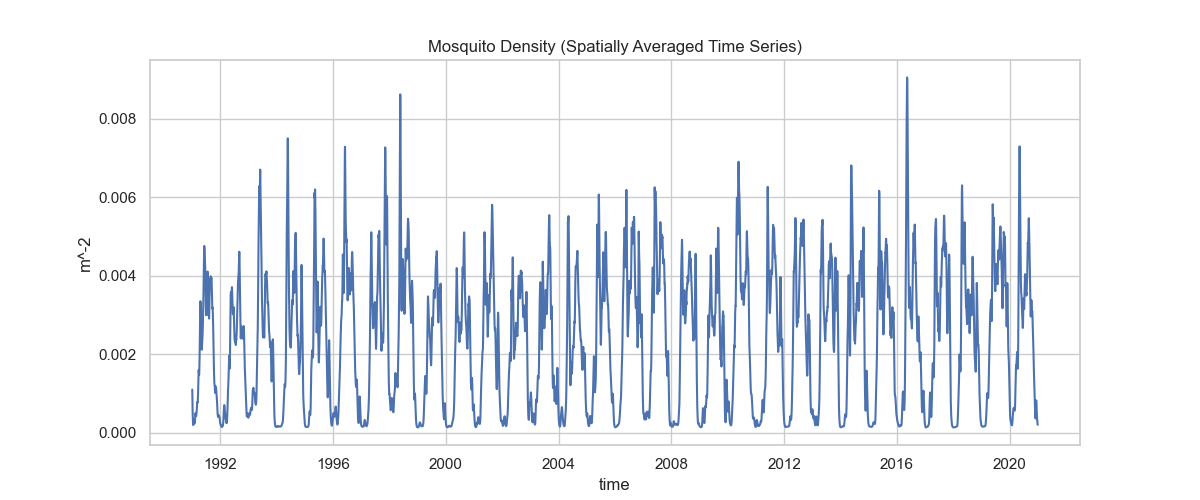
Temporal Dynamics
Seasonal cycles in vector populations over time
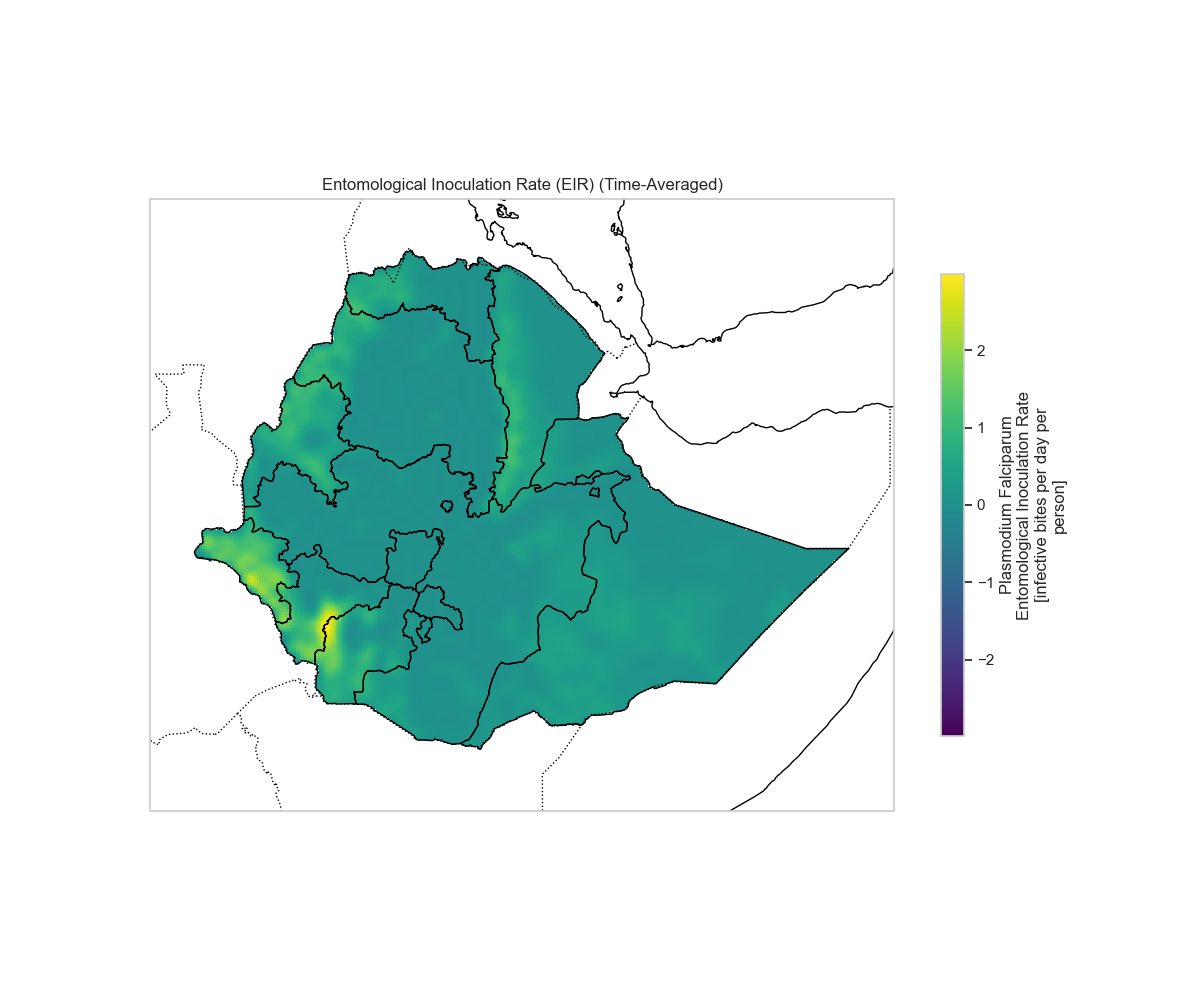
Disease Metrics
Entomological Inoculation Rate (EIR) distribution
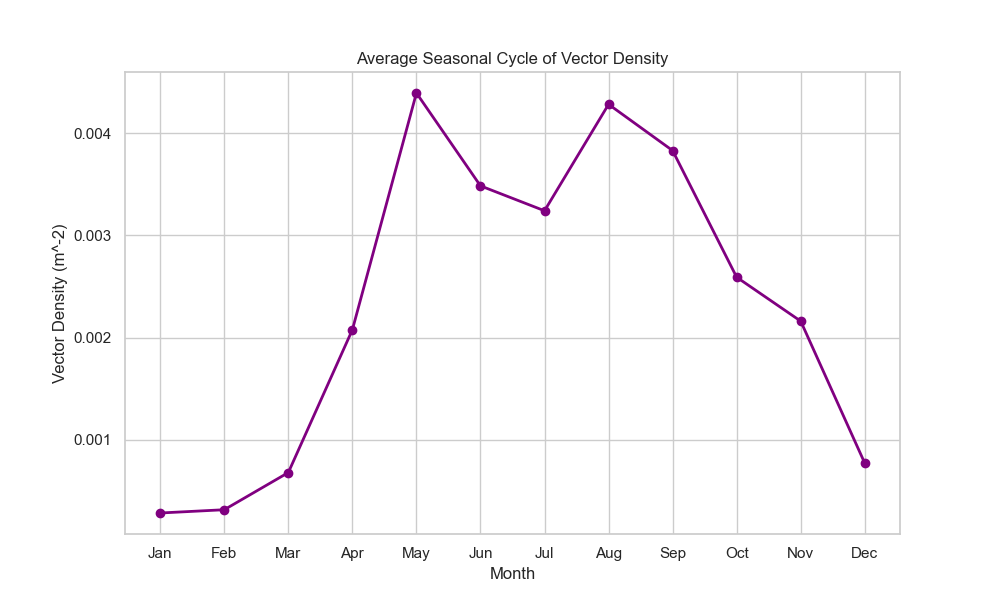
Seasonal Analysis
Average seasonal cycle of vector density
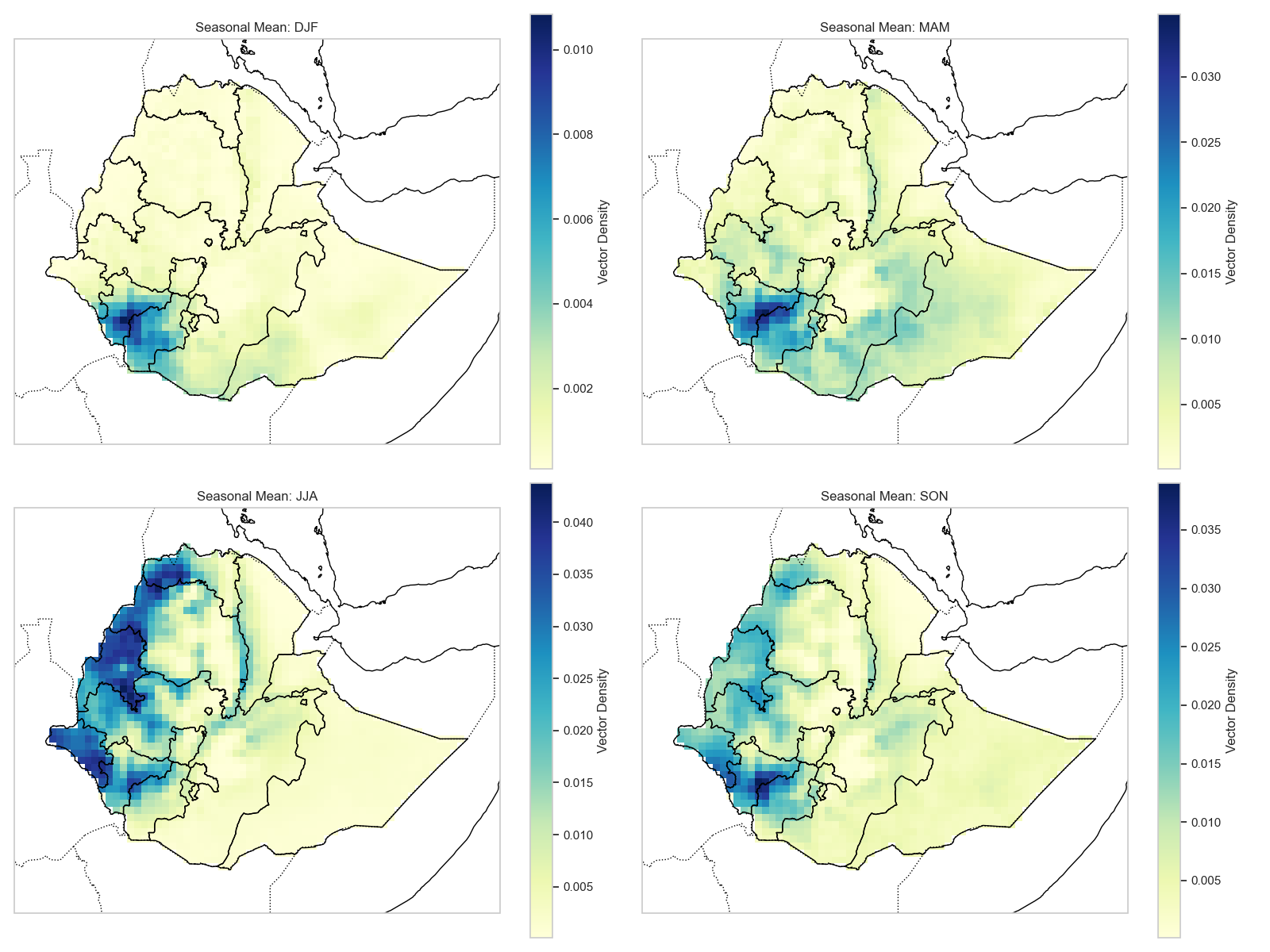
Seasonal Maps
Transmission patterns across different seasons
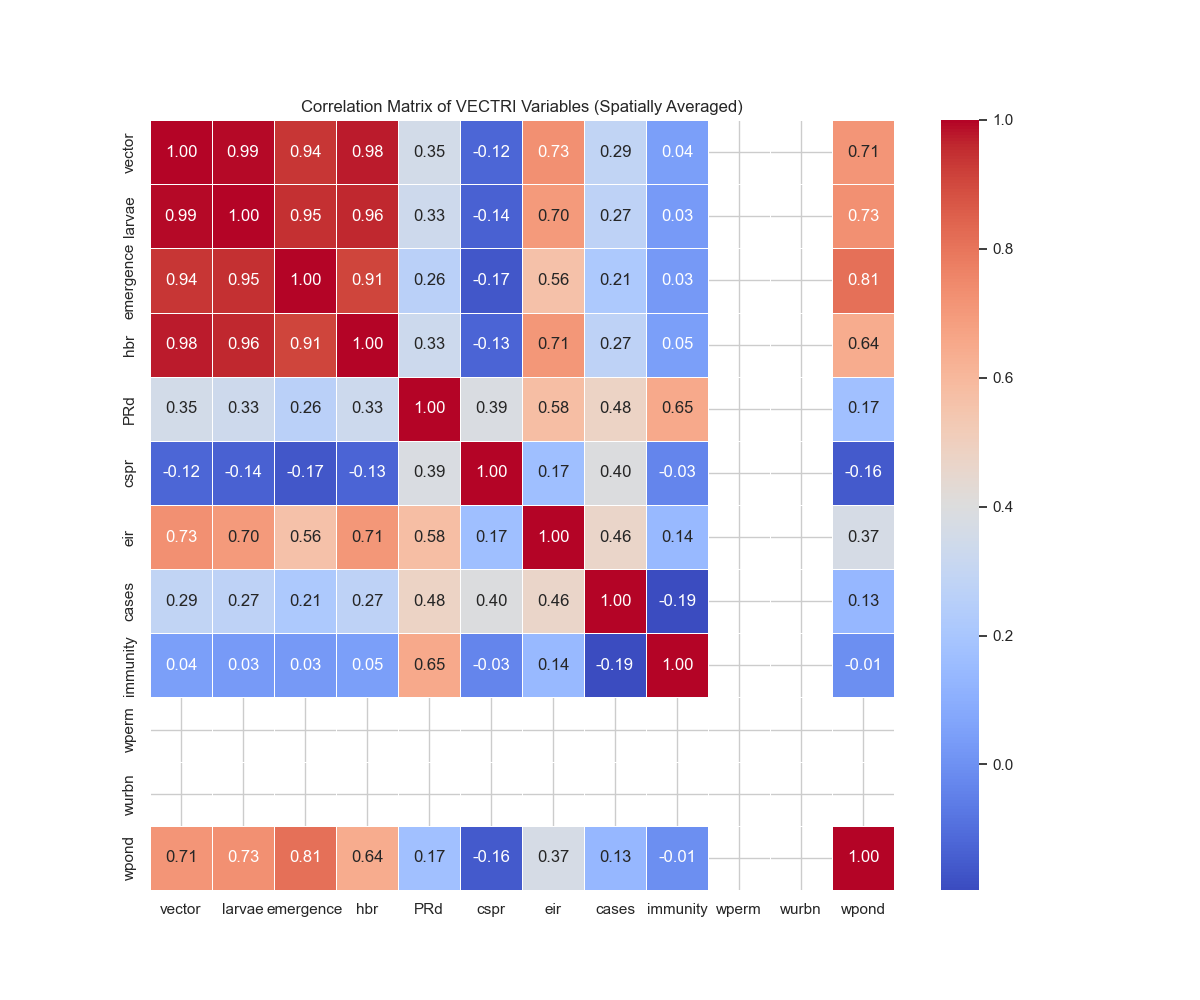
Variable Relationships
Correlations between key VECTRI variables
Overview
This training is designed to help participants understand how climate-driven malaria modeling using VECTRI can be used to enhance malaria early warning systems and support evidence-based public health interventions in Ethiopia. In particular, this training is prepared in collaboration between the Swedish Meteorological and Hydrological Institute (SMHI) and Addis Ababa University (AAU) to support participants from the Ethiopian Meteorological Institute (EMI).
It will cover both foundational concepts and hands-on practical applications using real-world data from the Amhara region. This training is financed by the Swedish International Development Cooperation Agency (Sida) as part of the Water and Climate Change Services for Africa, Ethiopia (WACCA-E), phase 2 project.
Workshop Details
| Dates | Monday–Friday, December 8–12, 2025 |
| Time | 09:00–17:00 daily (UTC+03:00, Addis Ababa) |
| Duration | 5 Days |
| Format | In-person (mix of lectures, practical exercises, and discussions) |
| Participants | Up to 15 participants |
| Venue | Elilly Hotel, Addis Ababa, Ethiopia |
Target Audience
- EMI health, hydrology and meteorology team
- Masters and PhD students from AAU
- Experts from Ethiopian Public Health Institute (EPHI)
Learning Outcomes
By the end of this training, participants will be able to:
- Source, quality check, and preprocess ERA5/CHIRPS climate data into daily, VECTRI-ready NetCDF format (rainfall, 2-m temperature)
- Compile and run VECTRI; interpret outputs (EIR - Entomological Inoculation Rate, HBR - Human Biting Rate, cases) and evaluate lags (EIR→cases)
- Understand the biological basis of malaria transmission and how climate variables drive vector and parasite dynamics
- Create environmental input files (population, soil type) for VECTRI modeling
- Conduct spatial and temporal analysis of model outputs to identify malaria transmission hotspots and seasonal patterns
Daily Structure (Quick Glance)
| Day | Theme | Lessons | Focus |
|---|---|---|---|
| Day 1 | Foundations | 6 lessons | Theory, VECTRI introduction, model components |
| Day 2 | Setup and Python Basics | 5 lessons | Environment setup, Linux, Python fundamentals, NumPy |
| Day 3 | Advanced Python and Climate Data | 6 lessons | Data processing libraries, climate data access |
| Day 4 | VECTRI Setup and Running | 5 lessons | VECTRI configuration, execution, output analysis |
| Day 5 | Advanced Analysis | 2 lessons | Advanced visualizations, parameter sensitivity |
Requirements
Prerequisites
- Basic Python programming skills (Pandas, NumPy, Matplotlib)
- Basic Linux command-line skills
- Personal laptop (Linux preferred; Windows users must have WSL2 installed)
Software & Tools
- Python 3.8+ (Jupyter Notebooks)
- VECTRI model (compiled from source)
- Linux/Unix environment (native or WSL2)
- NetCDF utilities
Key Datasets
-
Climate:
-
Rainfall
- Historical: CHIRPS, ARC2, TAMSAT
- Near-real-time: NCEP-GFS, ECMWF HRES
- Sub-seasonal: ECMWF S2S, ECMWF S2S Ensemble
- Seasonal: ECMWF Seasonal (C3S)
- Long-term projections: CHC-CMIP6, CMIP6, ISIMIP3b, Regional products (e.g. CORDEX)
-
Temperature:
- Historical: CHIRTS, ERA5-Land, ERA5
- Near-real-time: NCEP-GFS, ECMWF HRES
- Sub-seasonal: ECMWF S2S, ECMWF S2S Ensemble
- Seasonal: ECMWF Seasonal (C3S), NCEP CFSv2, NMME
- Long-term projections: CHC-CMIP6, CMIP6, ISIMIP3b, Regional products (e.g. CORDEX)
-
-
Population data:
-
Soil Type/Soil Fraction:
-
Geographic:
- Administrative boundaries (shapefiles) GADM/FAO GAUL
-
Malaria: EPHI confirmed case data
Facilitators
Dr. Teferi Demissie
International Livestock Research Institute (ILRI)
Dr. Bode Gbobaniyi
Swedish Meteorological and Hydrological Institute (SMHI)
Yonas Mersha
International Livestock Research Institute (ILRI)
Interactive Learning with Binder
Experience hands-on learning with our interactive Jupyter notebooks! No installation required - just click and start coding.
 Launch Interactive Environment
 Includes all lessons, sample climate data, and pre-configured Python environment.
💡 What is Binder?
A free service that turns our GitHub repository into a live, interactive Jupyter environment. Perfect for following along with lessons or experimenting with code!
💬 Real-Time Collaboration
Join our dedicated real-time collaborative space for Q&A, notes, and discussions during training sessions:
For more collaboration options, visit our full collaboration guide.
Participants List
| No. | Name | Department/Desk | |
|---|---|---|---|
| 1 | Tarekgn Abera | ISOMS | tatarish59@gmail.com |
| 2 | Desalegn Tarekgn | Health Met | desalegntarekegn@gmail.com |
| 3 | Ayalew Tassew | HealthMet | ayalewtasew8@gmail.com |
| 4 | Tamirat Yohannes | Hydromet | yohannestamirat81@gmail.com |
| 5 | Alemu Gamini | Hydro met | alemugamini@gmail.com |
| 6 | Kidus Belay | Agromet | kibe_302001@yahoo.com |
| 7 | Yimer Assefa | Agromet | yimera649@gmail.com |
| 8 | Gebremariam Adane | Healthmet | gebremariamadane@gmail.com |
| 9 | Sintayhu Tewabe | Agomet | santazewdu18@gmail.com |
| 10 | Chaka Natai | Halthmet | chakanatae832@gmail.com |
| 11 | Rahele Yirdaw | MFEW | rahelyirdaw21@gmail.com |
Contact
For inquiries about this workshop, please contact:

Yonas Mersha
Hydro-Climate Modelling and ML/AI Expert
International Livestock Research Institute (ILRI)